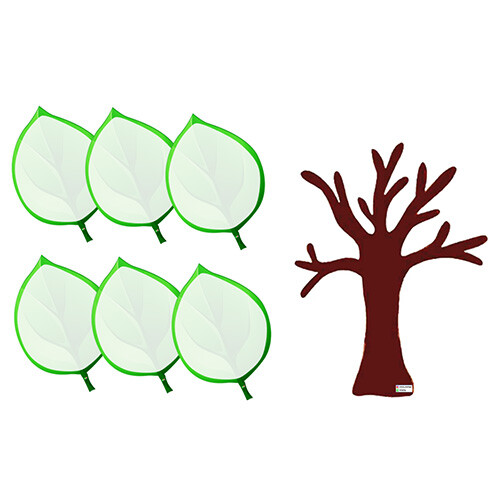
Memory tree
Strategy Details
- Strategy Name: Memory Tree
- Number of Cards: 7 cards, with a magnetic adhesive on the back
- Size: 7 A4 cards
- Strategy Type: An educational strategy in the form of laminated whiteboard cards.
Components:
- Tree and Leaves: The strategy consists of one card representing a tree without leaves and six cards representing leaves. The tree is designed in brown, and the leaves are light green, aimed at capturing learners' attention and motivating them to actively participate.
Educational Purpose:
- Enhancing Memory: The strategy aims to enhance learners' memory skills by associating information with the leaves that are attached to the tree.
- Teaching Classification and Sequencing: The leaves can be used to represent different pieces of information that learners need to classify and arrange correctly on the tree.
- Developing Motor Skills: Physical interaction plays a significant role in this strategy, as learners place the leaves on the tree themselves, helping to develop fine motor skills.
Usage Method:
- Memory Recall: The teacher gives learners specific information linked to the leaves, then asks them to recall this information and place the leaves on the correct part of the tree.
- Classifying and Sequencing Information: The leaves can be used to classify and sequence information on the tree, such as arranging events chronologically or categorizing words by type (nouns, verbs, adjectives).
- Educational Games: Learners can be divided into groups, with each group tasked with placing the leaves on the tree according to certain instructions, promoting teamwork and critical thinking.
Benefits:
- Motivating Learners: The simple and attractive design of the cards encourages learners to participate and increases their engagement in educational activities.
- Enhancing Memory: By associating information with the leaves and tree, the strategy helps learners improve their ability to remember and recall information.
- Developing Motor and Visual Skills: Activities that involve physical interaction, such as placing leaves on the tree, help develop fine motor and visual skills.
- Teaching Classification and Sequencing: The strategy encourages learners to think critically and analytically by classifying and sequencing information correctly.
Additional Notes:
- Adaptation for Different Age Groups: The activities can be adjusted to meet the needs of various age groups and educational levels.
- Integration with Other Subjects: This strategy can be used across multiple subjects, such as science (plant life cycles), language (word classification), and social studies (historical event sequencing).
Conclusion:
The "Memory Tree" strategy is an innovative and effective educational tool that contributes to enhancing learners' memory skills in an interactive and enjoyable way. By using the tree and leaves as educational tools, teachers can offer a variety of activities that support the development of memory, classification, sequencing, and fine motor skills. This strategy provides an engaging learning environment that helps achieve educational goals in a fun and interactive manner.
Price
3.500 KWD
1