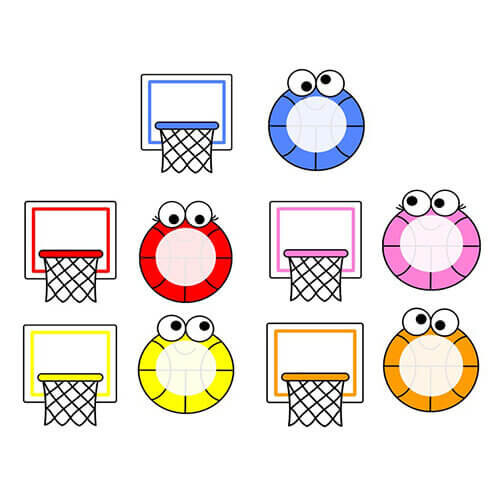
Basketball is half and the other half
Strategy Name: Basketball: Half and the Other Half
Number of Cards: 10 cards, with adhesive magnets on the back
Size: 10 cards A4
Strategy Type: Educational strategy in the form of laminated whiteboard cards.
Components:
- Baskets and Balls: The strategy consists of 5 cards representing basketball hoops and 5 cards representing different colored balls (blue, red, yellow, orange, pink). The cards are designed so that each half of the balls can be matched with the appropriate basket.
Educational Purpose:
- Teaching matching and classification: The strategy aims to teach students how to match the halves of the balls with the appropriate baskets, thereby enhancing their logical thinking and classification skills.
- Developing fine motor skills: By moving and arranging the halves of the balls on the baskets, students learn how to coordinate between the eyes and hands, which helps improve fine motor skills.
- Enhancing learning through play: The strategy provides a fun learning experience through play, encouraging students to actively participate in educational activities.
Usage Instructions:
- Writing questions on the cards: The teacher can write questions or instructions on the halves of the balls and ask students to answer or match them with the baskets.
- Matching the halves of the balls: The teacher can guide students to match the halves of the balls with the appropriate baskets based on color or shape.
- Linking information and organizing concepts: The cards can be used to link information or organize different educational concepts, such as arranging numbers or letters.
- Arranging letters and words: The cards can be used to arrange letters or words to form sentences or meaningful words.
- Error correction and multiple choice: The teacher can use the cards to correct mistakes or present multiple-choice questions, where students choose the correct answer from the available options.
- Interactive games: Students can be divided into groups to compete in matching the halves of the balls with the baskets correctly and as quickly as possible, encouraging teamwork and social interaction.
Benefits:
- Motivating learners: The innovative design of the balls and baskets makes learning more exciting and motivates students to participate.
- Teaching matching and classification skills: The strategy helps improve students' matching and classification skills through practical activities.
- Enhancing visual and motor understanding: The activities associated with the strategy contribute to improving motor coordination and enhancing visual understanding.
Additional Notes:
- Adaptation to different ages: Activities can be adjusted to suit different age groups and educational levels.
- Integration with other subjects: This strategy can be integrated with other subjects such as mathematics (arranging numbers) and language (teaching new words).
Conclusion:
The "Basketball: Half and the Other Half" strategy is an effective educational tool that combines learning with fun, helping to enhance students' matching skills and their visual and motor understanding. By using the ball and basket cards, teachers can offer engaging educational activities that support the achievement of educational goals in interactive and enjoyable ways.
Price
4.500 KWD
1