Lido
Details:
- Number of elements:
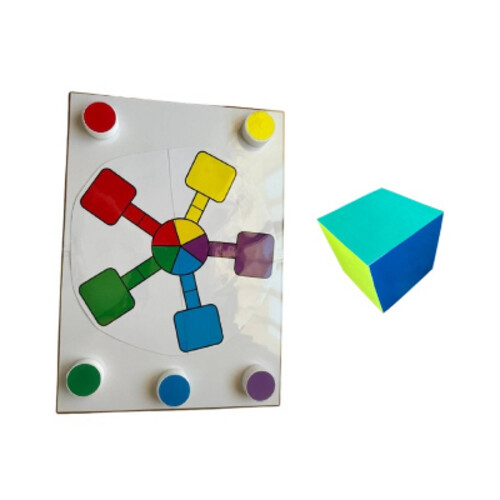
- Ludo game board, A2 size.
- Dice made of colored foam.
- Small foam circles placed on the board and moved according to the dice color after rolling.
Materials:
- The board is made of thick paper and laminated for durability and ease of use.
- The dice is made of lightweight foam for safe and easy handling.
- The colored circles are made of foam to make them lightweight and easy to move.
Description:
- Design:
- A large A2-sized board featuring a circular design divided into several colored sections (red, yellow, green, blue, etc.), each associated with an educational task.
- The dice has faces in colors matching the sections on the board.
- Foam circles are used as game pieces and are moved according to the color rolled on the dice.
Usage:
- This strategy engages students by having them roll the dice and move the corresponding colored circle on the board to a specific point to complete the associated task.
Objective:
- Strengthen collaboration and active participation among students.
- Develop color-matching skills and encourage logical thinking.
- Add an element of fun and interaction to promote active learning.
How it works:
- The ludo board is placed on the table or floor where students can sit around it.
- The teacher assigns tasks or questions to the different colored sections of the board.
- A student rolls the foam dice to determine the color.
- The student moves the foam circle matching the color to the corresponding section.
- The student reads the task or question in the section and answers it in front of their classmates.
Applications:
- Teaching letters and words:
- Assign each color to a letter or word, and the student must say a word that begins with the chosen letter.
- Teaching math operations:
- Write math problems for each color and have students solve them.
- Creative writing activities:
- Include story prompts or open-ended questions, and the student must complete the task based on the color they select.
Target audience:
Children in kindergarten and elementary school levels.
Benefits of the strategy:
- Provides a fun and innovative educational experience.
- Captures students' attention with sensory elements like the foam dice and colored circles.
- Promotes teamwork and cooperation among students.
- Encourages concentration and creativity, making learning more engaging.
Price
Save 1.000 KWD
4.750 KWD
5.750 KWD
1